
Unlock Real-Time Location Tracking Anywhere: ESP32 GPS Tracker with SIM800L & NEO-6M
Build your own compact, reliable ESP32 GPS tracker with SIM800L cellular connectivity and NEO-6M satellite positioning for real-time, cloud-based location tracking anywhere with 2G coverage.

Have you ever wanted a DIY project that combines robust microcontroller capability with real-time global tracking, limited only by Wi-Fi range? The innovative ESP32 GPS tracker with SIM800L and NEO-6M brings exactly that—empowering makers, hobbyists, and professionals to build a compact tracker, perfect for vehicles, deliveries, or exploring GPS technology hands-on.
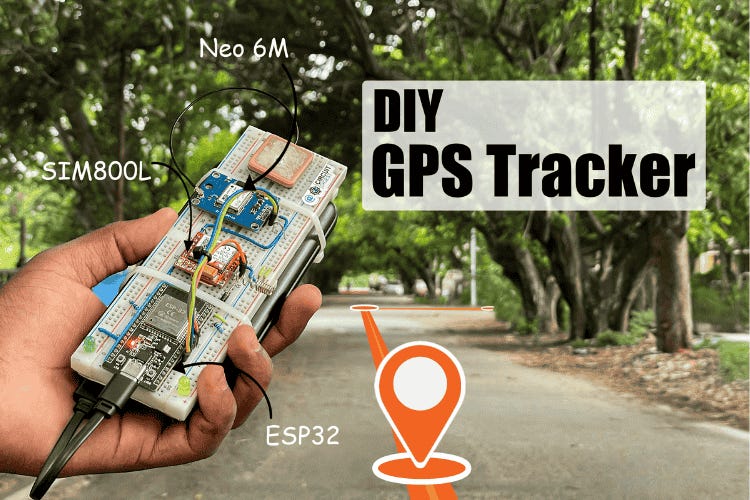
Why This Project Stands Out
Works Anywhere With Cellular Coverage: Unlike Wi-Fi trackers, the integration of the SIM800L module means that your tracker works even in remote areas with no Wi-Fi—anywhere 2G GSM is available.
Real-Time Location With GPS: The NEO-6M GPS module ensures you get reliable, accurate position data, typically within 2.5–10 meters, depending on real-world conditions. No need for complex setups; the system syncs its position directly to a cloud dashboard—GeoLinker—for instant visualisation on any device.
Expandable and Adaptable: The setup covers essential hardware (ESP32, SIM800L, NEO-6M, LEDs), but the design encourages adding sensors as needed, making it ideal for future expansion or custom requirements.
How It Works
At its core, the ESP32 collects GPS data from the NEO-6M module and uses the SIM800L to transmit this data over the mobile internet, updating your trip details live on the GeoLinker cloud platform. Wiring is straightforward for those familiar with breadboarding, and the entire codebase uses a single installed library—GeoLinker—for managing GPS parsing, GSM communication, cloud uploads, offline buffering, and more.
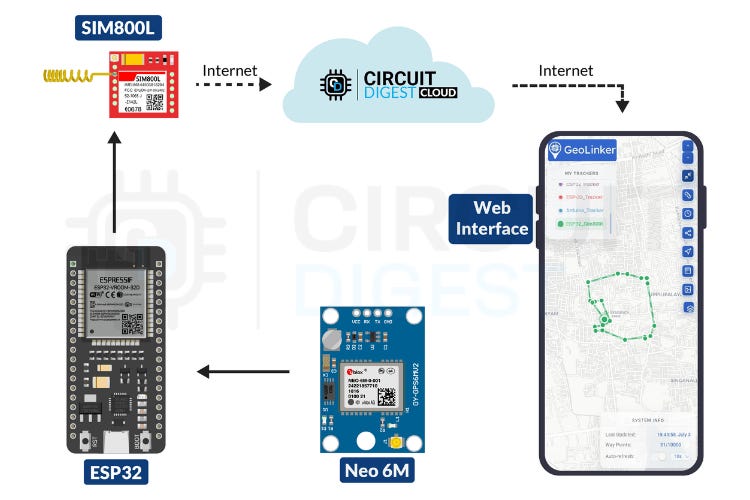
Key Components Needed:
ESP32 development board
SIM800L GSM/GPRS module
NEO-6M GPS module
LEDs for visual status indicators
Simple Workflow:
Register for GeoLinker: Create your free account and get an API key.
Build and Wire Your Circuit: Follow the provided diagrams—powering, connecting UART pins, and attaching status LEDs.
Upload the Code: Plug in the credentials, API key, and intervals (e.g., report every 30 seconds).
Test and Go!: Power on, watch for LED indicators, and follow your device’s real-time movement on the online dashboard.
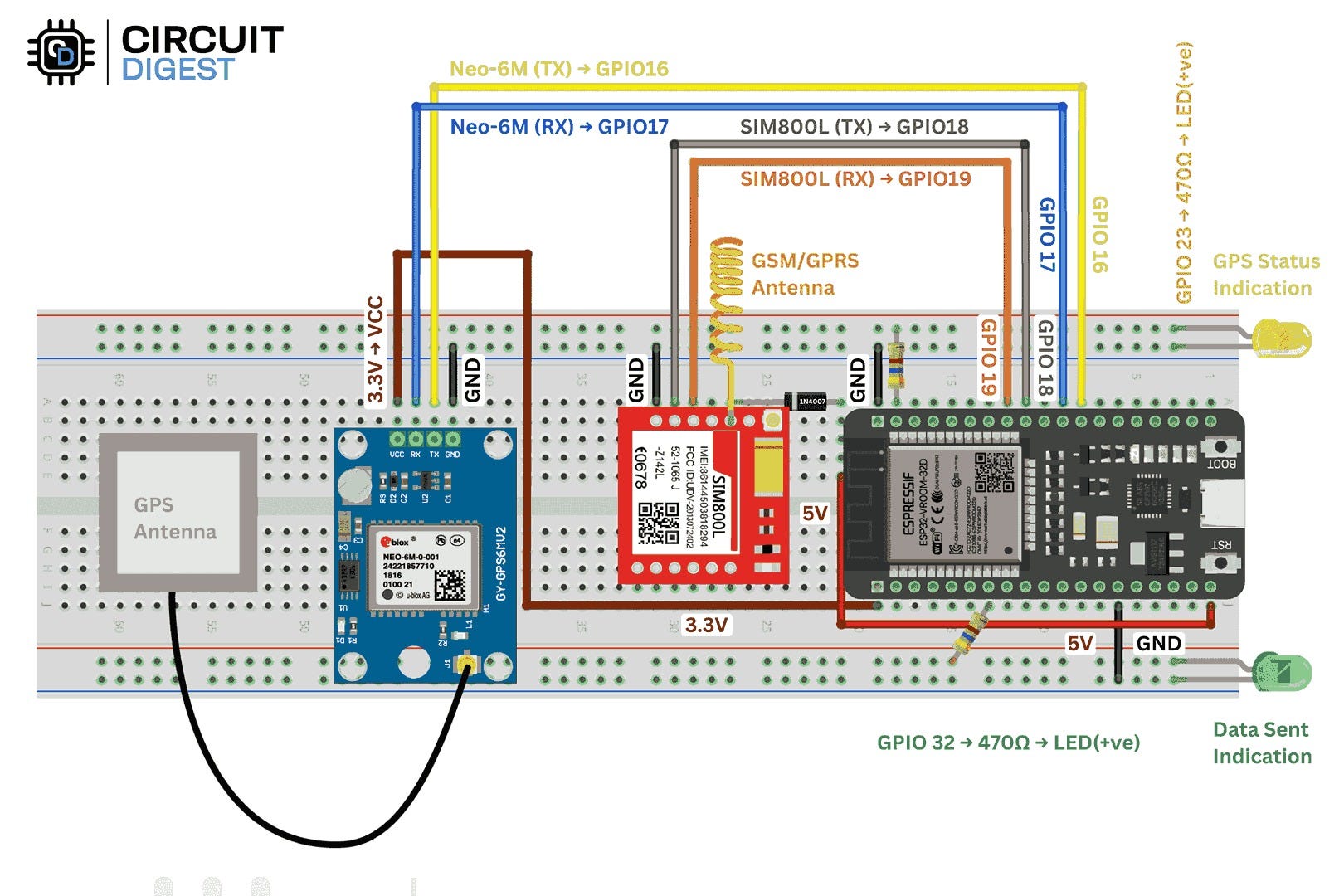
Why Use Cellular (SIM800L) Over Wi-Fi?
Wi-Fi works only in known, preconfigured areas. With the SIM800L, your tracker roams as far as the local 2G network reaches—ideal for outdoor and vehicular tracking far from urban centers. The ESP32’s Wi-Fi can work for indoor or local tracking, but for true mobility, cellular is the answer.
Troubleshooting and Tips
Power Supply: The SIM800L needs a steady 3.7-4.2V; use a Li-Ion battery or suitable regulated sources.
Antenna Positioning: For fast GPS lock, provide a clear view of the sky.
Data Usage: Tracking every 30 seconds consumes about 10–20 MB/month—affordable for continuous updates.
SIM Cards: Ensure your provider still supports 2G; in India, Airtel, Vi, and BSNL are recommended.
Perfect For:
DIY vehicle and asset tracking
Fleet management prototypes
Learning IoT and cloud integration
Experimenting with GPS and GSM in embedded systems
Ready to build yours? Check the full ESP32 GPS Tracker with SIM800L for schematics and code, and start tracking your world in real-time. Share your builds, tweaks, or application ideas in the comments to foster a practical, idea-sharing community!
This project can be your gateway into real-world, deployable IoT solutions—expand it, adapt it, and bring your location-tracking visions to life.