
Inside the E88 Drone: Teardown, Secrets & Design
A deep hardware breakdown of the E88 drone revealing its MCU, sensors, RF system, and engineering secrets behind budget quadcopter flight.

Introduction: Why Tear Down a Budget Drone?
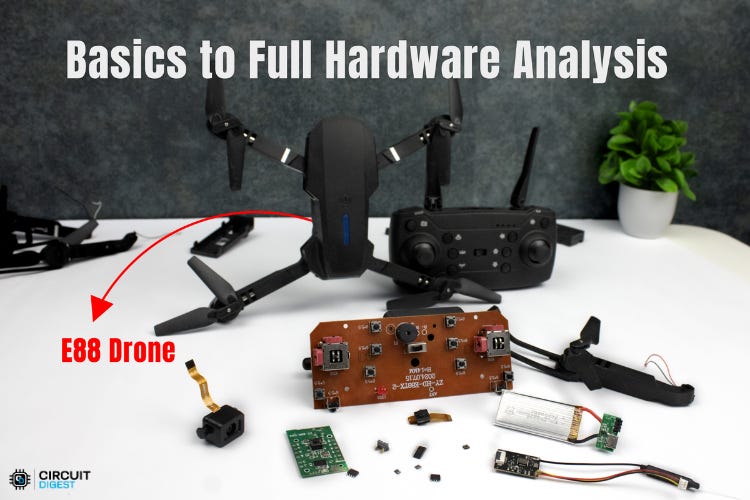
What makes a ₹2000 drone fly, stabilize itself, stream video, and respond instantly to commands? That question led to a fascinating teardown and hardware analysis of the E88 quadcopter—a popular entry-level drone designed for beginners and hobbyists.
This blog dives into the internal architecture of the E88 drone, uncovering the components, electronics, and engineering decisions that enable stable flight, wireless control, and real-time feedback. Whether you’re an electronics enthusiast, embedded systems learner, or drone hobbyist, this teardown offers valuable insight into how modern quadcopters work.
(Original teardown source: CircuitDigest)
Overview: What Makes the E88 Drone Special?
The E88 is a consumer-grade quadcopter featuring:
Foldable arms for portability
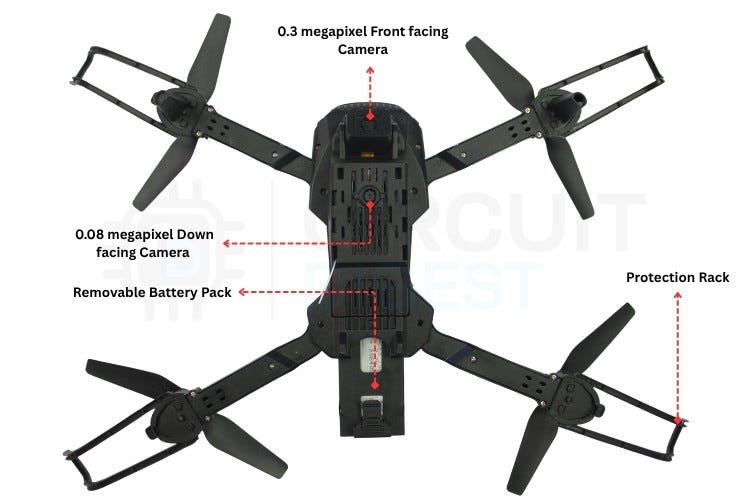
WiFi camera for live video streaming
Altitude hold capability
Lightweight plastic construction
Beginner-friendly controls
Its compact design and affordable price make it a perfect platform to understand drone electronics and embedded systems fundamentals. Despite being a budget device, it contains sophisticated flight control logic and multiple integrated electronic subsystems.
Package Contents and Controller Design
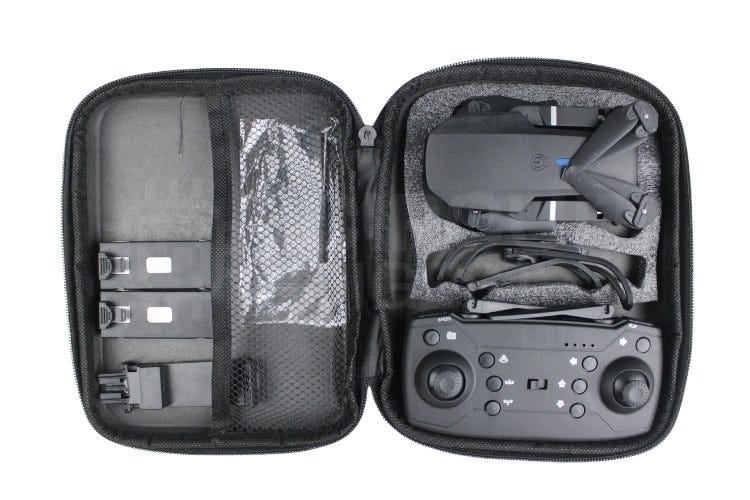
The drone package includes:
E88 drone unit
2.4 GHz wireless controller
Rechargeable 3.7V Li-ion batteries
USB charging cable
Spare propellers
Carrying case
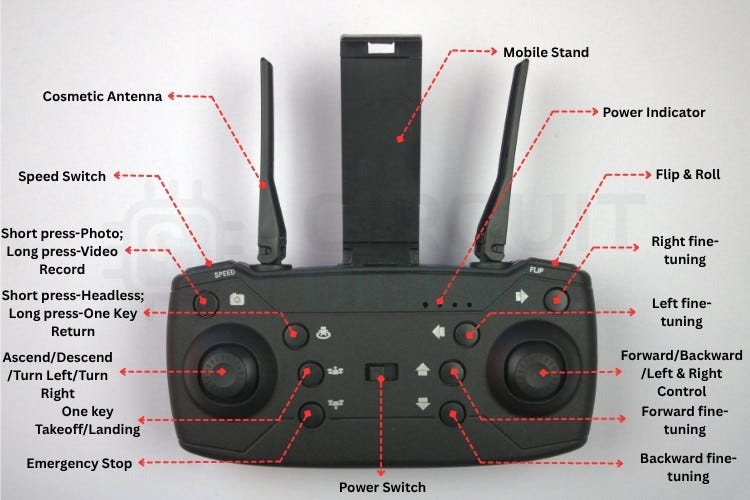
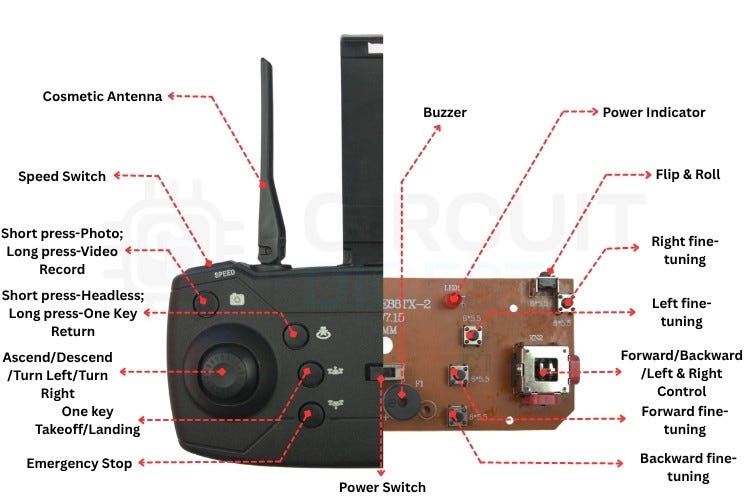
The controller uses a standard Mode-2 layout:
Left joystick → throttle and yaw
Right joystick → pitch and roll
One-key takeoff/landing button
Speed control modes
Emergency stop function
This layout enables intuitive control for beginners and experienced pilots alike.
Internal Hardware Architecture
The E88 drone consists of two main electronic subsystems:
Flight controller (inside drone)
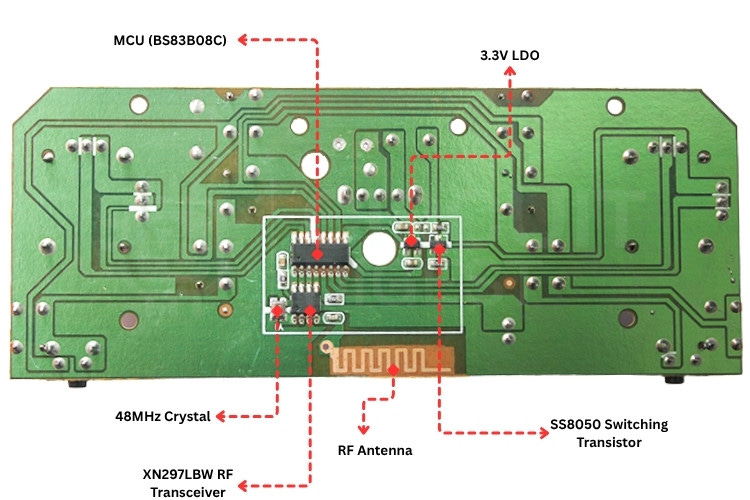
Wireless controller (handheld remote)
These communicate via a 2.4 GHz RF wireless link.
Core Flight Controller Microcontroller
At the heart of the drone lies a suspected STM32F030F4P6 microcontroller featuring:
ARM Cortex-M0 architecture
48 MHz processing speed
Real-time flight control processing
PWM motor control signals
Sensor data processing
This MCU executes control loops, stabilizes the drone, and manages all flight operations.
Sensor System: How the Drone Maintains Stability
Two key sensors enable stable flight:
Gyroscope (L3GD20H)
Provides angular rotation data, allowing the drone to:
Detect orientation changes
Stabilize motion
Maintain smooth flight
Sampled at high frequency for precise control.
Barometric Sensor (BMP180)
Enables altitude hold by measuring atmospheric pressure.
This allows the drone to:
Hover automatically
Maintain constant height
Reduce pilot workload
These sensors work together using sensor fusion algorithms to maintain flight stability.
RF Communication System
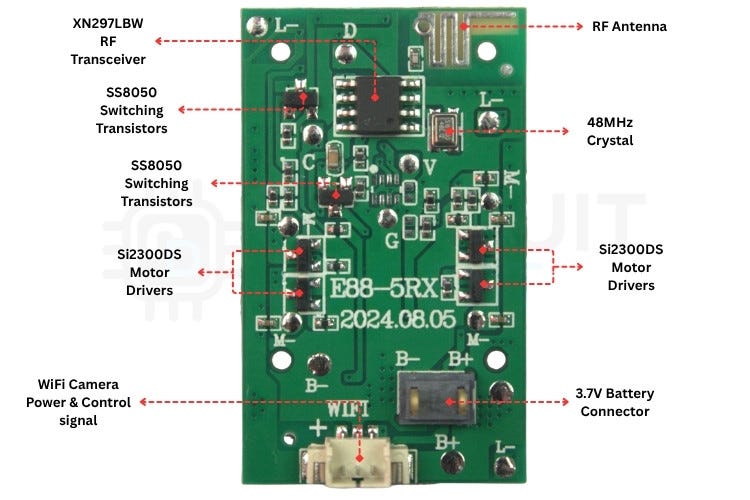
The drone uses the XN297LBW RF transceiver for wireless communication.
Key features:
Frequency: 2.4 GHz ISM band
Range: 50–80 meters
Low latency communication
Reliable command transmission
The controller continuously sends commands such as throttle, direction, and flight modes to the drone in real time.
Power Management System
The drone is powered by a 3.7V Li-ion battery with approximately 1200 mAh capacity, providing around:
8–10 minutes of flight time
Power regulation is handled using voltage regulators and protection circuits to ensure stable operation.
A charging IC manages safe battery charging using constant current and constant voltage techniques.
Motor Control System
The E88 uses four coreless DC motors arranged in quadcopter configuration.
Each motor is controlled using MOSFET drivers, enabling:
Precise speed control
Efficient power usage
Stable thrust balancing
The microcontroller generates PWM signals to control motor speed and direction.
WiFi Camera Integration
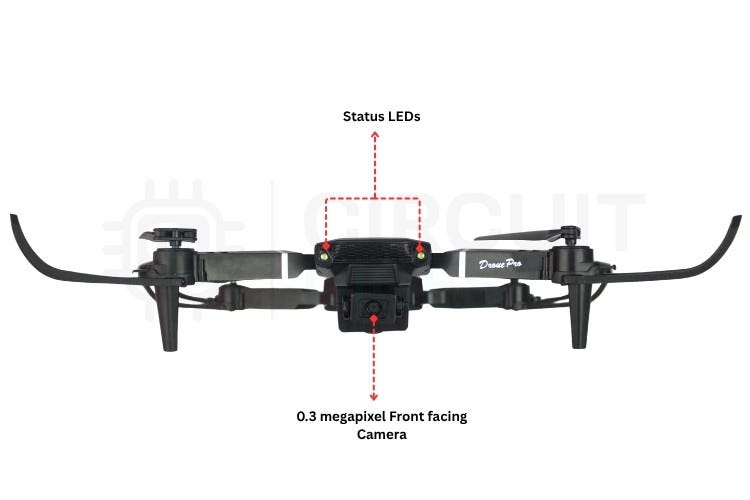
The onboard camera module allows live video streaming via WiFi.
Features:
Real-time video feed to smartphone
FPV (First Person View) capability
Wireless access point connection
However, video quality is limited due to low bitrate, which is common in budget drones.
Flight Control Algorithm and System Workflow
The drone uses embedded firmware that continuously performs:
Sensor reading
Orientation calculation
Motor speed adjustment
RF command processing
The control loop runs approximately 250 times per second, ensuring smooth and responsive flight.
Engineering Insights from the Teardown
The teardown reveals several important engineering principles:
Efficient Embedded Design
Low-power microcontroller ensures efficient battery usage.
Sensor Fusion
Combining gyroscope and barometer improves stability.
Modular Architecture
Independent modules for power, RF, and camera simplify design.
Cost-Optimized Hardware
Careful component selection keeps cost low while maintaining functionality.
Limitations of Budget Drones
While impressive, the E88 has limitations:
Fragile plastic construction
Limited camera quality
No firmware customization
Not suitable for professional applications
It is primarily designed for recreation and beginner learning.
What This Teardown Teaches Us
The E88 drone demonstrates how modern electronics enable advanced functionality even in low-cost devices.
Key takeaways:
Embedded systems power modern drones
Sensor integration enables autonomous stability
RF communication enables real-time control
Efficient power design maximizes battery life
Even budget drones incorporate advanced engineering principles.
Final Thoughts
The E88 drone teardown offers an excellent glimpse into modern quadcopter design. It shows how microcontrollers, sensors, RF communication, and power electronics work together to create a fully functional flying system.
For electronics students, hobbyists, and embedded engineers, studying devices like this is one of the best ways to understand real-world hardware design.
Affordable drones like the E88 prove that powerful embedded systems are no longer limited to expensive platforms—they are now accessible to everyone.